In short: A German CV (Lebenslauf) is a tabular, reverse-chronological document — dates in a left column, content on the right, newest first. It opens with a personal-data block (and usually a photo), then work experience, education and skills. Keep it to 1–2 pages, use month/year dates, and account for any gaps. It’s factual, not a persuasive US-style résumé.
The German CV is the single most important document in your application — recruiters read it first and weight it above everything else. The format is strict but learnable, and the details that trip up internationals are mostly about convention, not your qualifications. Here’s how to get it right. (New to any of the German terms below? They’re all in the glossary.)
The format: tabular and reverse-chronological
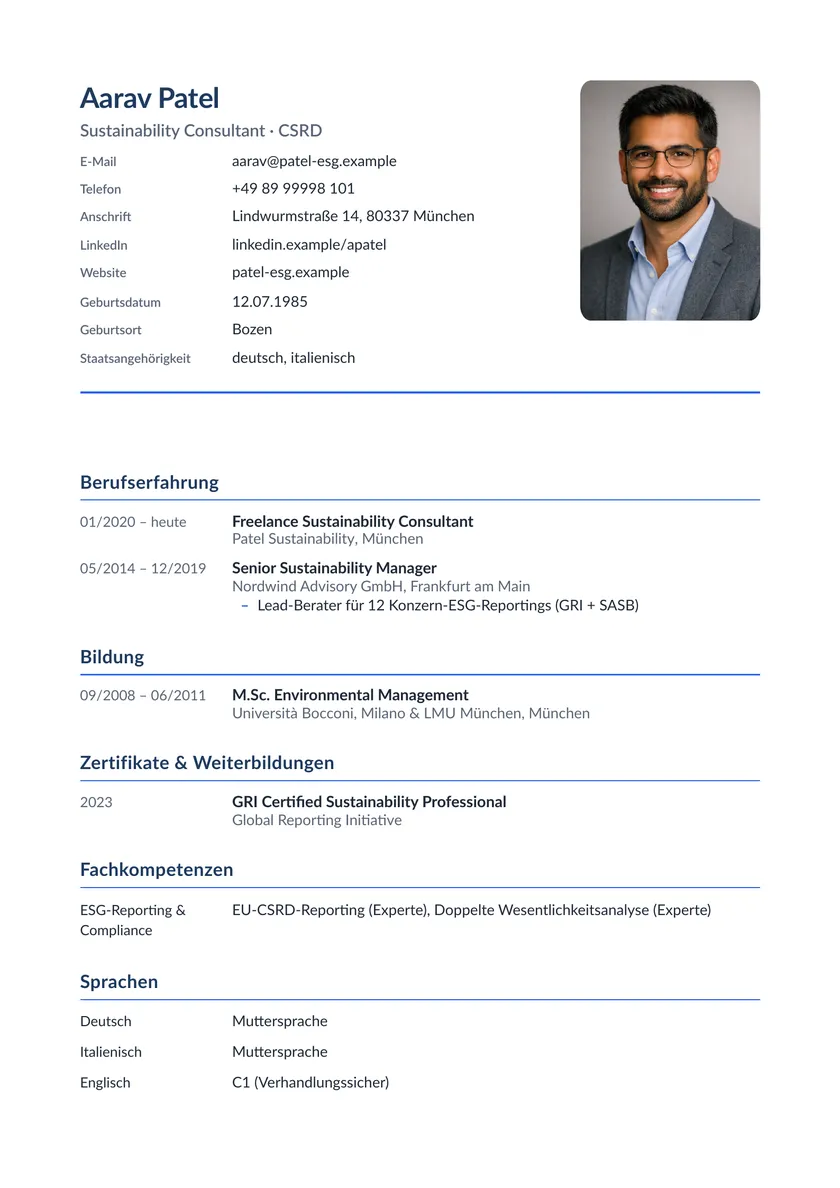
A German CV is a table, not prose. There’s no US-style “professional summary” paragraph selling your story — just clearly dated, structured entries. German career guides describe it as a factual record (Tatsachendokument) rather than a marketing document, and that framing explains most of the rules below. Two of them define the shape:
- Tabular (tabellarisch): dates in a left column, content on the right. Bullet points, not paragraphs.
- Reverse-chronological (antichronologisch): within every section, the newest entry first.
Keep it to one to two pages (two is normal for experienced professionals; sources differ on whether three is ever acceptable — treat two as the target). Put the word “Lebenslauf” as the title at the top.
This is what the finished document looks like — a real render, German conventions applied to an international profile:
What goes at the top: personal data
The CV opens with a personal-data block. Here’s what to include — and what German anti-discrimination law (AGG) makes optional:
- Always: full name, postal address, phone, email.
- Customary: date and place of birth.
- Optional (worth including if non-German): nationality — it also quietly answers the employer’s work-permit question.
- Private — increasingly omitted: marital status, religion, children. You’re under no obligation to state them.
- Drop entirely: parents’ occupations, siblings, maiden name.
The AGG works in a direction that surprises many internationals: an employer may not demand a photo, your date of birth, marital status or religion — but you’re free to include them, and several remain customary. A short “Kurzprofil” (profile summary) at the very top is a modern add-on, not a canonical part of the standard — use it if it helps, but it’s optional, not expected. The photo is the detail internationals wonder about most — see the full rundown in Do you need a photo on a German CV?
Applying from a US/UK background? Putting your date of birth, a photo and your nationality on a CV feels wrong — there, it invites bias claims. In Germany it’s the norm. The conventions genuinely flip between markets, which is why JACVault lets you toggle the photo and adapt these per application.
The order: what comes first
The correct order in a German CV is reverse-chronological: the newest entry comes first in every section, then the CV works backwards in time. If you come from a US or UK background, that habit transfers — it’s one of the few things that doesn’t flip. What does change is the vocabulary: in German usage, a “chronologischer Lebenslauf” is the old variant that starts with your oldest entry and is rarely used today. What Americans call a “chronological resume” is what Germans call antichronologisch. Worth knowing before you read German-language advice — the words point in opposite directions.
The canonical sequence of sections:
- Persönliche Daten (personal data) — and photo
- Berufserfahrung (work experience) — leads for experienced applicants
- Ausbildung / Bildungsweg (education) — may lead for graduates
- Fort- und Weiterbildung (further training) — optional
- Kenntnisse und Fähigkeiten (skills)
- Sprachen (languages)
- Interessen / Hobbys — optional
- Unterschrift (signature) — optional
Expected sections: personal data, work experience, education, skills. Everything else is optional.
Work experience or education first?
Relevance decides, not a fixed rule. If you’re established in your career, work experience sits directly under your personal data — it’s your strongest argument, and education follows below. Fresh graduates flip it: without substantial roles, the degree carries the application, so education leads. Whatever you choose, the within-section order stays newest-first.
Career changers
The same relevance logic covers a career switch: the section — and within it, the entries and skills — closest to the target role moves up, and transferable skills get named explicitly instead of hiding inside old job titles. A German CV is not a fixed artifact you send everywhere; the weighting follows the role you’re applying for. (That per-role weighting is exactly how JACVault builds each CV from your profile.)
The date format: MM/YYYY
Month and year, no days: 02/2016 – 08/2020. Every station gets a start and an end date, and a current role is marked “seit 03/2023” (since 03/2023) or “bis heute” (to date). Avoid year-only dates: “2016 – 2020” could hide eight months, and German recruiters read it exactly that way — year-only dates are a gap-hiding signal, not a style choice. The uniform format has a second purpose: applicant-tracking software sorts your stations by precisely these dates.
Work-experience entries
Each entry has four parts: the date range, your position, the employer (full name + location), and your tasks and achievements. Format them as a two-column table with bullets:
- Bullets, not prose: typically 3–6 per role, covering tasks and results — concrete, naming tools and projects.
- Quantify: German recruiters explicitly want numbers and results. A useful frame is Problem → Action → Result, with a figure attached.
- Scale the detail: describe your last two or three roles fully; summarize or drop anything more than ~10–15 years back.
Tip: use the exact job title from your Arbeitszeugnis (reference letter) so your documents line up — more on those here. No German reference letters yet because you’ve never worked here? That’s normal for newcomers, and the same guide covers what to attach instead.
Skills and languages
- Hard skills go in the CV; soft skills belong in the cover letter — don’t list “teamwork, communication” as bare keywords here.
- IT skills: call the section “IT-Kenntnisse” (not the dated “EDV”), group by category, and name the concrete tools — a bare “MS Office” says nothing. Keep it in list form — no star ratings, no skill bars: the graphics look tidy but contain no readable text for an applicant-tracking system, and German convention favors named levels anyway.
- Languages — the German ladder, lowest to highest, with what each word means: Grundkenntnisse (basic) → gute Kenntnisse (good working knowledge) → fließend (fluent) → verhandlungssicher (business fluent — literally “negotiation-proof”) → Muttersprache (native). Add the CEFR level (A1–C2) alongside so the entry reads internationally, and name certificates (TOEFL, Goethe, telc, DELF).
- Stating your German level is one of the most valuable lines on an expat’s CV: German at B2/C1 is a genuine selling point — state it clearly, with the CEFR band. But be honest in both directions. An overstated language level that was a hiring criterion can justify termination later — this isn’t a soft convention but employment-law reality — and you should expect interviews to test whatever level you claim. The same honesty decides which language you write the CV in: match the job ad, and default to German when in doubt.
What’s out in 2026
Older German CV templates — the kind that still dominate free template sites — carry fields that are simply gone from a current CV. If you googled a German Muster and it shows these, drop them:
| Drop it | Why |
|---|---|
| Parents’ occupations, siblings | A relic of the school-student CV, with zero relevance to the role |
| Religion / denomination | Private — and since the AGG, explicitly nothing an employer may ask for |
| Elementary school | Once you have work experience, your education section starts later |
| Salary figures | If they belong anywhere, it’s the cover letter — never the CV |
| ”EDV-Kenntnisse” and bare “MS Office” | A dated term and an empty claim: name the tools and your level |
| Driving license without a mobility link | Only relevant if the role involves driving or field work |
The frame around the CV is gone, too: the classic printed application folder (Bewerbungsmappe) is dead. Applications run through online forms or as a PDF by email, and the overwhelming majority of German employers prefer the digital route. What used to be the plastic folder is now your file name — descriptive, with your name in it.
Formatting at a glance
24 values from font size to page margins — click to expand
The quick-reference card. Two things to know first: German CVs are built on A4 paper (21 × 29.7 cm — slightly narrower and taller than US Letter), and every value here follows the German career-portal consensus, so you can use the table as-is.
Length & structure
| Value | Note | |
|---|---|---|
| Length | ≤ 2 pages | two A4 pages is the ceiling |
| Career starters | 1 page | with little experience, one page is enough |
| Rule of thumb | 1 page per 10 years | a rough sizing guide, not a law |
| Order | reverse-chronological | newest entry first, in every section |
| Date format | MM/YYYY | e.g. 02/2016 – 08/2020, no days |
| Current role | ”seit 03/2023” | or “bis heute” (to date) |
Typography & form
| Value | Note | |
|---|---|---|
| Body text | 11–12 pt | 10 pt is the absolute floor |
| Headings | 1–3 pt larger | roughly 13–15 pt, set in bold |
| Line spacing | factor 1–1.15 | tighter looks crowded, looser looks padded |
| Typefaces | 2 typefaces at most | one for body text, one for headings |
| Serif vs. sans | genuinely open | German career guides disagree — legibility and consistency decide |
| Accent color | exactly 1 accent color | used sparingly; it doesn’t replace structure |
| Margins | left 2.5 cm | right 1.5–2 cm, top and bottom about 2.5 cm — up to 4.5 cm on top if a header runs along |
| Bold | headings + job titles | the main emphasis — sparing, one system throughout |
| Italics | subtle only | the second, softer level — never in bulk |
Content amounts
| Value | Note | |
|---|---|---|
| Bullets per role | 3–6 bullets | tasks and results, no prose paragraphs |
| Fully described | last 2–3 roles | everything older gets compressed |
| Compression line | 10–15 years | further back: one line, or drop it |
| Short profile | 3–4 lines | optional, factual, never salesy |
| Hobbies | 3–4 entries | only with a visible link to the role |
| Gap without explanation | up to ~2 months | from about three, label it neutrally |
| Photo | 4.5 × 6 cm | portrait, top right — optional; details in the photo guide |
File & delivery
| Value | Note | |
|---|---|---|
| File format | text-based PDF | real text, not an image or scan |
| File name | descriptive | with your name and the document type in it |
Employment gaps
A “complete” CV (lückenloser Lebenslauf) is one where every period is named — not one without interruptions. You’ll meet the word lückenlos in job ads and German career advice, and it’s the single most misread term by internationals: it does not mean your CV must be gap-free. Gaps up to about two months need no explanation at all; from roughly three months without a visible activity, add a neutral label. Gap-free careers are the minority anyway: according to LiveCareer’s Career Gap Report 2025 (1.8 million CVs analyzed), only 46% of applicants had a CV without any gap — ten percentage points fewer than in 2022.
The rule is honesty in neutral language — label each gap, don’t hide it:
| Situation | How to label it |
|---|---|
| Parental leave | ”Elternzeit” or “Familienphase” — as a dated entry (never omit; that leaves a multi-year hole) |
| Illness | ”aus gesundheitlichen Gründen” — never name the diagnosis |
| Job search | ”arbeitssuchend” or “berufliche Neuorientierung” — never “arbeitslos” |
| Sabbatical / travel | frame it with what you gained (languages, organization) |
| Further training | list the specific courses and dates |
Two hard don’ts: never lie or invent positions (grounds for dismissal even after hiring), and never use year-only dates to hide a gap — month/year is expected, and year-only reads as concealment. → Full guide: employment gaps on a German CV.
Foreign qualifications
Your degree isn’t German — that’s fine, but pre-empt the recruiter’s uncertainty:
- On the CV, state the original degree, institution and country, and (helpfully) the German equivalent.
- Check anabin — the free official KMK database — to see how your institution and degree are rated (
H+= recognized institution; degree labels like gleichwertig / entspricht = equivalent). - If anabin doesn’t clearly list your degree, a ZAB Statement of Comparability maps it to a German level (Bachelor/Master). It costs €208; processing is ~3 months (2 weeks on the EU Blue Card track).
- The key distinction: for regulated professions (doctor, teacher, nurse…) formal recognition is legally required before you work. For non-regulated professions (most IT, business, engineering roles) you can apply directly — a comparability statement is a helpful addition, not a legal must.
The signature — and DACH differences
In Germany, signing your CV (place, date and a handwritten signature at the bottom) is optional but customary — a small professionalism signal. Online portals often skip it.
If you’re applying across the DACH region, note the deltas:
| Germany | Austria | Switzerland | |
|---|---|---|---|
| CV signature | Optional, customary | Expected (per ÖNORM, name repeated in type) | Usually omitted — no signature, no place/date |
Build it without the guesswork
That’s a lot of conventions to hold in your head per application. JACVault reads your background once and lays it into a German-standard CV — tabular format, photo handling, DACH variants — then keeps it pixel-perfect and ATS-ready. Already have a CV? Import it instead of retyping — it’s read into your profile and reshaped to the German standard from there. And if you’re wondering about the software filter: three rules cover most of ATS reality in Germany — familiar section headings, a text-based PDF, and the terms from the job ad. The rest is in the ATS guide. Your first application is free.
Start for free → · CV & Resume Builder for Germany · Browse CV templates · Back to: the full application process
General information about German CV conventions, not legal advice — especially on degree recognition, check the official sources linked above. Last reviewed: see the date at the top.