In short: A gap-free CV is not expected in Germany — “lückenlos” means every period is named, not that there are no interruptions. Gaps up to about two months need no explanation at all; from roughly three months, give the phase a brief neutral label as a dated entry: “Elternzeit” for parental leave, “arbeitssuchend” (never “arbeitslos”) for a job search — and yes, there is an honest way to label the months around your move to Germany. Never invent anything, and never use year-only dates to hide a break.
Internationals often panic about gaps because Anglo advice treats them as red flags to disguise. In Germany the expectation is different — and calmer: gaps aren’t hidden here, they’re named. This guide walks through every common case with the exact German wording, including the ones that only exist when you move countries. (The format itself — dates, order, length — lives in the German CV guide.)
The “gapless CV” myth — what lückenlos really means
You’ll meet the word lückenlos (“gapless”) in job ads, in German career advice, and in almost every English-language forum thread about German CVs. Expat guides pass it on almost word for word — Germans, they say, like to read “gapless” CVs — and internationals on career forums repeat it back in a stricter form still: the German CV, one applicant is told there, has to show an unbroken line, with no interruption anywhere in it.
Taken literally, that’s the single most misread term in the German application. A “complete” CV (lückenloser Lebenslauf) is one where every period is named — not one without interruptions. German recruiters see interrupted careers every day and know that almost no working life runs without a break. Gap-free careers are the minority anyway: according to LiveCareer’s Career Gap Report 2025 (1.8 million CVs analyzed), only 46% of applicants had a CV without any gap — ten percentage points fewer than in 2022.
So the expectation is not an unbroken timeline. It’s an accounted-for timeline: every period carries a short, factual label, even the ones between jobs. What draws suspicion isn’t a gap — it’s a gap that’s hidden or unexplained. Once you see the rule that way, the rest of this guide is just vocabulary.
When a gap needs a label
The thresholds, as German career portals apply them:
- Up to about two months: no explanation needed at all. Changing jobs is allowed to take time.
- From roughly three months without a visible activity: add a neutral label as a dated entry.
- From three to four months: expect the gap to be noticed and asked about in the interview — label it clearly and prepare a sentence or two.
These are guidelines, not deadlines. And they only work because German CVs use month/year dates (02/2016 – 08/2020, a current role as “seit 03/2023” — since 03/2023): a visible two-month transition in that format is completely unremarkable.
Which brings up the habit you may have brought with you. US and UK advice often recommends blurring a gap — switching to year-only dates, or reformatting the whole CV “functionally” so durations replace dates. In Germany, both backfire: year-only dates are a gap-hiding signal, not a style choice (“2016 – 2020” could hide eight unexplained months, and recruiters read it exactly that way), and experience summaries without date ranges are read the same way. In the worst case, either is treated as attempted concealment and the application is sorted out. This is the one convention that genuinely flips: where you come from, hiding a gap may be tidy — here, naming it is.
One more answer up front, because it’s searched so often: simply leaving the period blank is not an option. An unnamed hole creates exactly the speculation you want to avoid — the reader doesn’t wonder whether something is behind it, but what. Almost any honest label beats the open hole.
What doesn’t count as a gap
A lot of what feels like a hole in your own timeline is, on a German CV, just a normal station — it only has to be named:
- Further training. A course or retraining program is initiative, not idleness — and German recruiters explicitly read it that way. Enter it as its own station (“Weiterbildung zum/zur …”) and put the certificate in your attachments.
- Time abroad. A gap year or work-and-travel phase stands for languages, independence and organization: “Gap Year, Work & Travel in …” is a station, not a gap.
- Self-employment — including a venture that didn’t work out. Anyone who founded something was working: a full station with dates, name and what you actually did. In Germany this is not read as a failure mark.
- The search after graduation. German employers grant new graduates a grace period of up to about six months for the first job search — named, for example, as “Orientierungs- und Bewerbungsphase” (orientation and application phase).
Gaps that come with moving countries
Now to the part German career portals rarely cover, because their readers never face it: the gaps that only exist because you moved. Three of them are near-universal in expat careers — and all three follow the same rule as everything above. Name the period, keep it factual, connect the dates.
The relocation itself — and the job search from abroad
There is no established German label for “I moved countries” — no portal prescribes one. So you build the line from parts that are established: the plain fact of the move, plus the standard active wording for a job search. For example:
11/2013 – 04/2014: Umzug nach Deutschland und aktive Arbeitssuche (relocation to Germany and active job search)
That single line, with month/year dates and no employer field, turns the relocation months from a suspicious hole into a self-explanatory station. The two details that matter: use the active job-search vocabulary (“aktive Arbeitssuche”, “Bewerbungsphase” — never the passive “arbeitslos”), and make the dates connect exactly to the stations before and after, so the timeline reads as continuous. If you ran your job search from abroad before the move, the same construction covers it — the label describes a phase, not a location.
Visa and recognition waiting periods
Waiting for a residence permit, a work visa, or the recognition of a foreign degree can easily consume months — and none of it is your performance as a professional. Two things are true at once here. First: you don’t need a special label for it, and you don’t have to disclose it. The reason behind a phase is your private business (more on that in the legal section below); the waiting months simply live inside your named relocation or job-search station. Second: the period itself must be correct. Don’t stretch a previous job’s end date to swallow the wait — shifted dates are exactly the kind of “small fix” German employment law treats as deception. If your degree is going through recognition, that’s worth a factual half-sentence in the CV or cover letter — the German CV guide covers foreign qualifications, anabin and ZAB in detail.
Language and integration courses
A German course is not dead time on a German CV — it’s one of the most respected things you can put in a gap. German portals list language courses among the classic, positively read ways to fill a search phase, and for internationals it does double duty: it accounts for the period and documents the skill employers care about most. Name it as its own station or as the second half of a combined one:
05/2024 – 10/2024: Sprachkurs Deutsch (B1 → B2) (German language course)
The same applies to the state Integrationskurs (integration course) — on the CV it’s a language course with a certificate, and the certificate goes in your attachments. A stated level of B2/C1 German is a genuine selling point on an international’s CV; which language you should then apply in is its own question, covered in English or German?
Compulsory military service
If your home country has mandatory military or civilian service, handle it like a job: it goes on the CV as a station of its own. A normal station with dates — “Wehrdienst” (military service) plus the country — needs no apology and no explanation beyond the label. German recruiters know the concept well; Germany itself had compulsory service until 2011. The one mistake would be leaving it off and creating an unnamed year.
The classic reasons — and the German label for each
The universal cases work the same in Germany as the moving-country ones: period named, phase labeled factually, no justification required. What changes is the vocabulary — these are the labels German recruiters expect to see.
Parental leave. Label the phase “Elternzeit” (parental leave) or “Familienphase” (family phase) as a dated entry — never omit it, because the omission creates a multi-year hole that invites far more questions than the leave itself ever would. If you worked part-time, studied or volunteered during the phase, add it: it upgrades the station.
Illness — including burnout and depression. A diagnosis never belongs on a CV. Not because illness is a flaw, but because health details are private, full stop — and that holds equally for surgery, rehab and mental health. The neutral label is “Auszeit aus gesundheitlichen Gründen” (time out for health reasons); if the phase is behind you, a short recovery signal helps: “inzwischen vollständige Genesung” (since fully recovered). That line is the honest and complete answer — you owe no one the word “burnout.” How open you want to be later, once trust exists, is your decision and your pace.
Caring for a relative. Whoever cared for a parent or partner — often, for expats, back in the home country — was working, just unpaid. It may stand in the CV as a station: “Berufliche Auszeit, Pflege eines Angehörigen” (career break, care of a relative). No details required, no guilt appropriate.
Sabbatical and travel. A deliberate time-out reads as self-knowledge if you name it: “Sabbatical”, plus a keyword or two on what it gave you (languages, organization, cultural skills).
Losing a job. A layoff for operational reasons is a fact, not a flaw — it can be named at the old station (“Kündigung wegen Insolvenz” — terminated due to insolvency) and followed by an active phase: “arbeitssuchend”. Whatever the circumstances: never a bad word about the former employer, even when you’re in the right. And keep the dates consistent with your reference letters — German recruiters cross-check the CV against the Arbeitszeugnis.
A changed or abandoned degree. A switch is a course correction, not a career end: “Akademische Neuorientierung, Wechsel des Studiengangs” (academic reorientation, change of degree program). The degree you finished afterwards answers the discipline question by itself; an abandoned program is still a named period, not a deleted one.
Wording at a glance
16 German CV wordings from Elternzeit to relocation — click to expand
The quick-reference card. The German column is what actually goes on the CV — each line as its own dated station in MM/YYYY format; the English column tells you what it means.
Named phases
| Situation | German CV wording | What it means / note |
|---|---|---|
| Parental leave | ”Elternzeit” or “Familienphase” | dated entry; never omit it |
| Illness (incl. burnout, depression) | “Auszeit aus gesundheitlichen Gründen” | time out for health reasons — never a diagnosis; add “inzwischen vollständige Genesung” if recovered |
| Caring for a relative | ”Berufliche Auszeit, Pflege eines Angehörigen” | career break, care of a relative |
| Sabbatical / travel | ”Sabbatical” or “Weltreise (…)“ | add what it gave you in keywords |
| Time abroad / gap year | ”Gap Year, Work & Travel in …“ | not a gap — a station |
| Further training | ”Weiterbildung zum/zur …“ | own station; certificate into attachments |
| Self-employment | full work station with name and dates | also a venture you wound down |
| Changed degree | ”Akademische Neuorientierung, Wechsel des Studiengangs” | academic reorientation |
Active wordings
| Situation | German CV wording | What it means / note |
|---|---|---|
| Job search (short) | “arbeitssuchend” | seeking work — never “arbeitslos” |
| Job search (longer) | “Aktive Arbeitssuche, Ziel: …“ | active job search, goal: … — fill with courses or self-study |
| Reorientation | ”Berufliche Neuorientierung, Fortbildung zum …“ | career reorientation + the activity |
| Entry after graduation | ”Orientierungs- und Bewerbungsphase für den Berufseinstieg” | the ~6-month graduate grace period |
Moving to Germany
| Situation | German CV wording | What it means / note |
|---|---|---|
| Relocation + job search | ”Umzug nach Deutschland und aktive Arbeitssuche” | relocation to Germany and active job search — no employer field |
| Visa / permit / recognition wait | no label of its own | the months live inside the relocation or job-search station; the reason stays private |
| Language / integration course | ”Sprachkurs Deutsch (B1 → B2)” or “Integrationskurs” | own station; certificate into attachments |
| Compulsory military service | ”Wehrdienst” + country | a normal station — treat it like a job |
Applying in Austria or Switzerland instead? Same rules, a few different words — parental leave is “Karenz” in Austria, a job search is “Stellensuche” in Switzerland.
Old gaps weigh less
The further back a gap lies, the less it matters — and the German CV format works in your favor here. The standard order is reverse-chronological, so older periods sit at the bottom, and the standard compression rule applies on top: describe your last two or three roles fully, and summarize or drop anything more than roughly 10–15 years back. A three-month gap from a previous decade doesn’t disappear — it stands there, cleanly named, and simply no longer interests anyone. You’re not hiding anything; you’re weighting the CV the way the German standard weights it anyway.
The rules that protect you — and the one hard line
German employment law is stricter than Anglo practice on one axis and more protective on another — and as an international, you should know both sides.
The protective side first. You are not obliged to disclose the reason behind a gap. Health, family planning, your private situation — under German anti-discrimination law (AGG), these are your business, and a neutral label fully satisfies the convention. No diagnosis, no visa story, no family details: “the period is named” is all that’s asked. Positive wording of real facts is explicitly allowed — “arbeitssuchend” instead of “arbeitslos” isn’t spin, it’s a truth with a better sign in front. And omitting things is largely allowed too: hobbies, and as a rule individual short stations — though every omission creates its own gap, and questions may follow.
The hard line. The German CV is treated as a factual document (Tatsachendokument): what you actively write in it must be true. Invented stations, shifted dates, upgraded titles or degrees — under German law an employer can challenge the employment contract for willful deception (arglistige Täuschung, § 123 BGB) or terminate without notice, even years after hiring: German labor courts have upheld dismissals over falsified application documents after five and after eight years on the job, because the clock only starts when the deception is discovered. In extreme cases — forged certificates — criminal law can come into play. There is no expiry date on a CV lie; there is one on almost every honest gap.
For gaps, the two sides meet in one sentence: the reason may stay private — the period may not be bent. Keep the dates exact and the label neutral, and both German law and German convention are entirely on your side.
Rule of thumb: an explained gap is a side note in the interview. A discovered lie is the end of the application — or, years later, of the job.
Gaps in the interview
From about three to four months of gap, expect to be asked about it in the interview even if it’s cleanly labeled on the CV — that’s routine diligence, not a trap. The confident answer is short: one or two calm, factual sentences — what the period was, and what you took from it — then steer back to your fit for the role. Prepare that answer word for word; the question you dread most tends to come first. Raising a gap proactively can look confident, but only with a genuinely good story — otherwise you’re answering questions nobody asked. And know your rights here too: some questions behind a gap — health, family planning — the employer may not even ask. Which questions are off-limits, and when German law grants an outright right to lie, is covered in the interview guide.
What a named gap looks like in the finished CV
This is the whole point in one image — a named relocation gap as a normal line between two positions, not a hole:
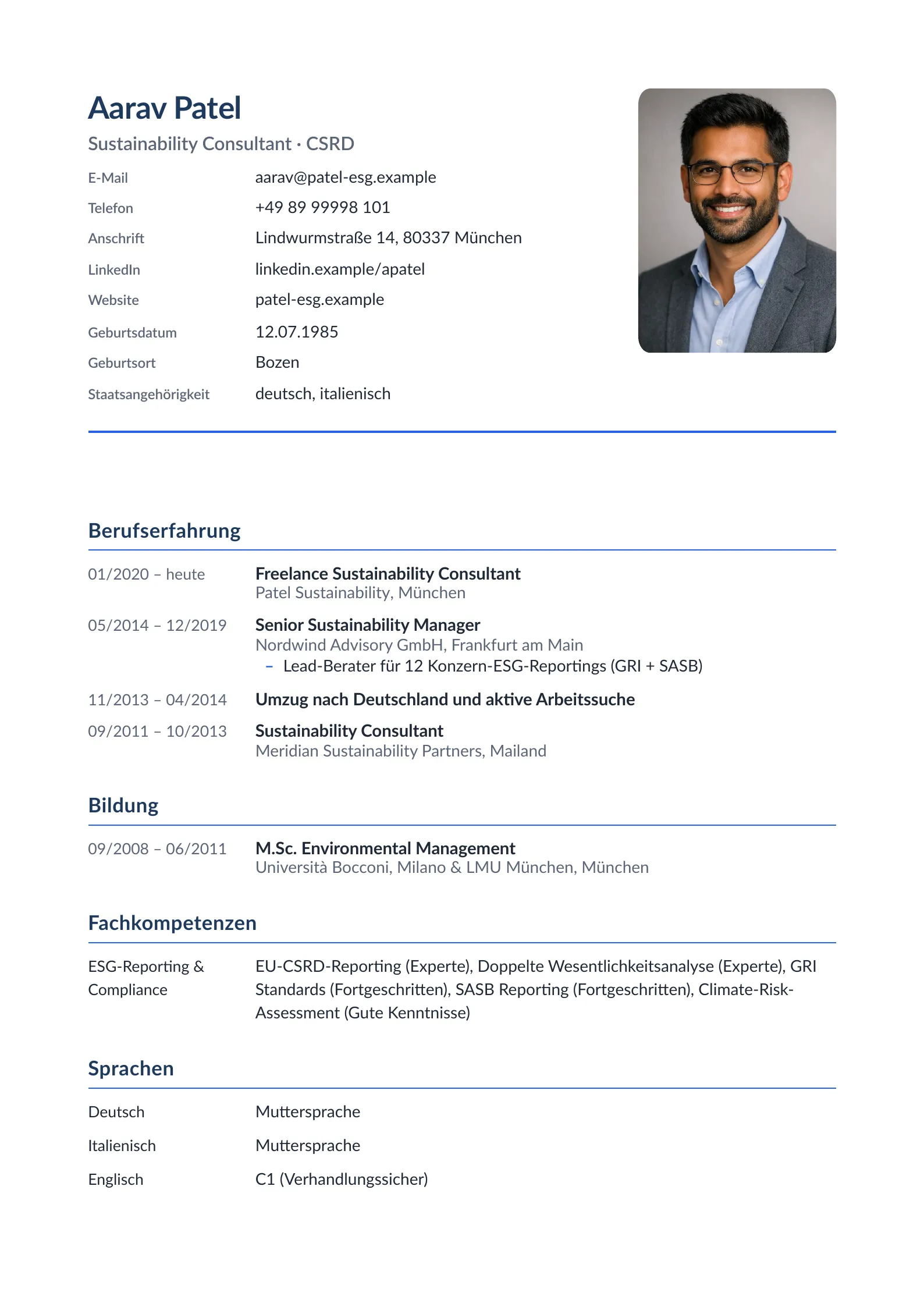
JACVault builds your CV from your real profile data — it invents nothing. A named phase like “Umzug nach Deutschland und aktive Arbeitssuche” is a station you enter in your profile yourself, with a date range and no employer field; in the finished document it renders as a normal line in MM/YYYY format, cleanly set and ATS-readable. The same fact principle applies when you import an existing CV: what’s read in is what’s there. Your first application is free.
Start for free → · The German CV guide · The full application process
General information, not legal advice. Last reviewed: see the date at the top.