In short: Match the language of the job posting. If the ad is in English (common at international companies and in tech), an English CV is fine. If it’s in German, or the company’s working language is German, a German-language CV is stronger — and when in doubt, German wins. Either way, keep the German format.
It’s the first question most internationals ask, and the answer is simpler than it looks — but there’s one part almost everyone gets wrong (it’s at the end). Here’s how to decide.
The one rule: match the posting
The safe, widely-agreed rule: write your application in the language of the job ad. An English-language posting signals the company is comfortable operating in English; a German posting signals it expects German.
There’s a sharper version of the same rule, and it’s worth having in mind when the ad itself is ambiguous: apply in the language that will be the everyday language of the role. If German is what’s spoken in that office, apply in German. Sending English to a German-speaking team leaves a gap in your application — the recruiter learns nothing about your German from it, and not knowing is worse for you than a modest but honest level.
If you truly can’t tell — a bilingual company, an ambiguous ad — default to German. It’s the lower-risk choice in the German market. Three things usually settle it before you have to guess: the language of the careers page, the language of the application portal and its confirmation email, and whether the ad names a required German or English level.
When English is genuinely fine
- International companies and multinationals whose working language is English.
- English-language job ads — they’ve told you.
- Tech, startups and research, where English is often the day-to-day language.
- Roles that are explicitly international or English-facing.
In these cases a polished English CV is not a disadvantage — it’s expected. Research is worth calling out separately: where a position at a German university or institute is advertised in English, the application language simply follows the call for applications, and nobody will read English as a gap.
When German is stronger
- German-speaking companies, especially the traditional Mittelstand (Germany’s mid-size companies) and family firms.
- Customer- or public-facing roles where you’ll work in German.
- Public sector and regulated fields.
- Anywhere the ad is in German.
Here, a German-language CV signals you can operate in the environment — and it quietly reassures the recruiter about your language level.
It’s worth being honest about how large this category is. Put the question directly — is fluent English enough for a developer job in Germany? — and the short answer is unflattering: English counts as a plus, German is quietly assumed. English-only offices do exist; a developer who has gone looking for one will tell you how thin the field is. There’s a second point that’s easy to miss: whatever language a company runs on internally, the work still reaches outside it — suppliers, contractors, public authorities, customers — and their paperwork is often in German. English as the sole working language is the exception in Germany, not the norm.
That doesn’t mean you need German to apply. It means you should know which kind of employer you’re writing to.
The loop nobody warns you about
If your German is somewhere in the middle, you’ve probably already hit the trap. It closes in three steps: good German comes from living in Germany, living in Germany is far easier with a job there, and the job in Germany wants good German. One applicant at B1, applying from abroad, sets out the four ways he can see out of it and dislikes every one: write everything in English and look like someone who won’t integrate; write in German and send something full of mistakes; pay a translator per application; or mix the two languages in one document.
The reply that dissolves the loop comes from the other side of the desk — from someone who hires in Germany. A correction pass by a German-speaking friend is enough, because nobody is holding a non-native applicant against native prose in the first place. What gets read closely is what you have done and why you want this particular job. And where the employer really does operate in English and that is clearly your stronger language, write in English and let the language line in your CV report the German.
So the practical resolution is neither of the two extremes:
- Write it yourself, then get it checked. A German-language application that you wrote and a native speaker corrected is worth more than a flawless one you couldn’t have produced — because the interview will happen at your level, not the proofreader’s.
- Don’t pay per application. If you want professional help, buy it once for a template you then adapt yourself, not once per employer.
- Don’t mix languages in one document. A German intro with English career details reads as unfinished, not as pragmatic.
- Put your German level in the CV either way. Whichever language you write in, the level line is what turns “unknown” into “B1, improving” — and that’s a far better position to negotiate from.
The cover letter is the harder half
Notice what the whole argument above is actually about: not the CV, the cover letter. That’s not a coincidence.
A German CV is mostly nouns, job titles, institutions and dates. It translates cleanly, and a second pair of eyes can check it in ten minutes. A cover letter (Anschreiben) is continuous prose in a formal register — it is the document where your actual command of the language is on display, sentence by sentence. This is why the honest answer to “which language” often differs between the two documents in practice, even though you should send them in the same one.
Two consequences worth planning around:
- Budget your effort asymmetrically. If you’re applying in German at an intermediate level, the letter is where the checking time goes. The CV needs accuracy; the letter needs fluency.
- Don’t let a translation tool write the letter. Machine translation produces German that is grammatically plausible and register-wrong — too casual, or stiff in a way no native speaker writes. That’s more conspicuous in a German-language application than a modest but genuinely written one.
What internationals get wrong
Two traps:
- Applying in English to a German-only posting. If the ad is entirely in German and you send English, it can read as “can’t (yet) do German” — sometimes fine, sometimes a quiet strike against you. There’s a second, less obvious cost, and it comes from the receiving end: someone on the hiring side of a German-speaking employer describes an unrequested English application as looking mass-produced — a file that went out to every address on a list, none of them looked at first. They set their own limit on it, too: in IT the tolerance is visibly higher. Fair or not, that’s the read you’re up against — and it’s the strongest practical argument for matching the posting.
- A bad German translation. A good English CV beats a clumsy machine-translated German one. If your German isn’t strong enough to produce clean, professional wording, either apply in English (where appropriate) or have the German version properly checked. Errors in a German CV undercut exactly the language competence you’re trying to signal — and overstating your German level can backfire later.
The part everyone gets wrong: the format stays German
This is the key point. Choosing English is a choice of language, not of format. An English CV for the German market should still follow the German conventions: tabular and reverse-chronological, a personal-data block, usually a photo, month/year dates, one to two pages, a factual tone.
What you should not do is send a US-style résumé in English — no photo, a “professional summary,” achievement-sales bullets. That’s not “an English application for Germany,” it’s an American application, and it reads as not knowing the local standard. (This is exactly where general AI tools trip up — more on that here.)
The reason the two get confused is that language and format hang on different things:
- Language follows the job ad — it’s a question of communication.
- Format follows the target market — the country where the job sits and where your CV gets read. It’s a question of convention.
German career portals make the same distinction, usually in a single sentence: for a company whose working language is English but whose office is in Europe, the norms of that European country apply. And the “no photo, no date of birth, no signature” rules that fill every article about the English CV are country rules — they come from anti-discrimination practice in the US, the UK, Ireland and Australia, not from the English language.
Simple Germany, writing for exactly this audience, puts it in one line: “Regardless of the language you choose for your CV, make sure to follow the standards German hiring managers expect.”
| The ad is in | The employer sits in | Language | Format |
|---|---|---|---|
| German | Germany | German | German standard |
| English | Germany | English | German standard |
| English | the UK | English | British CV |
| English | the US | English | US résumé |
Row two is the one almost every guide skips — and it’s the most common case for internationals in Germany. Here is what it actually looks like: the same CV header, rendered twice.
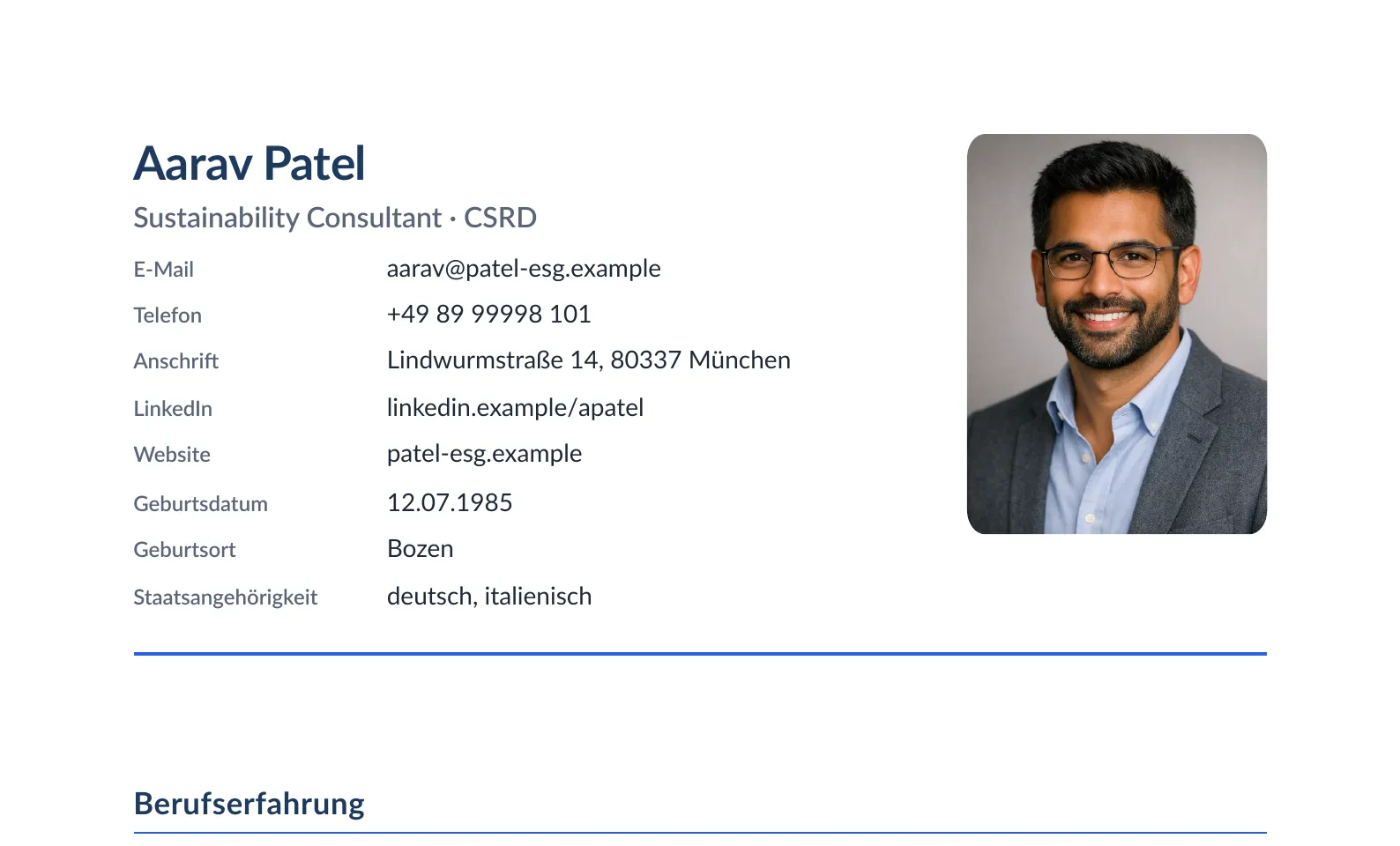
German version: E-Mail, Anschrift, Geburtsdatum, Staatsangehörigkeit
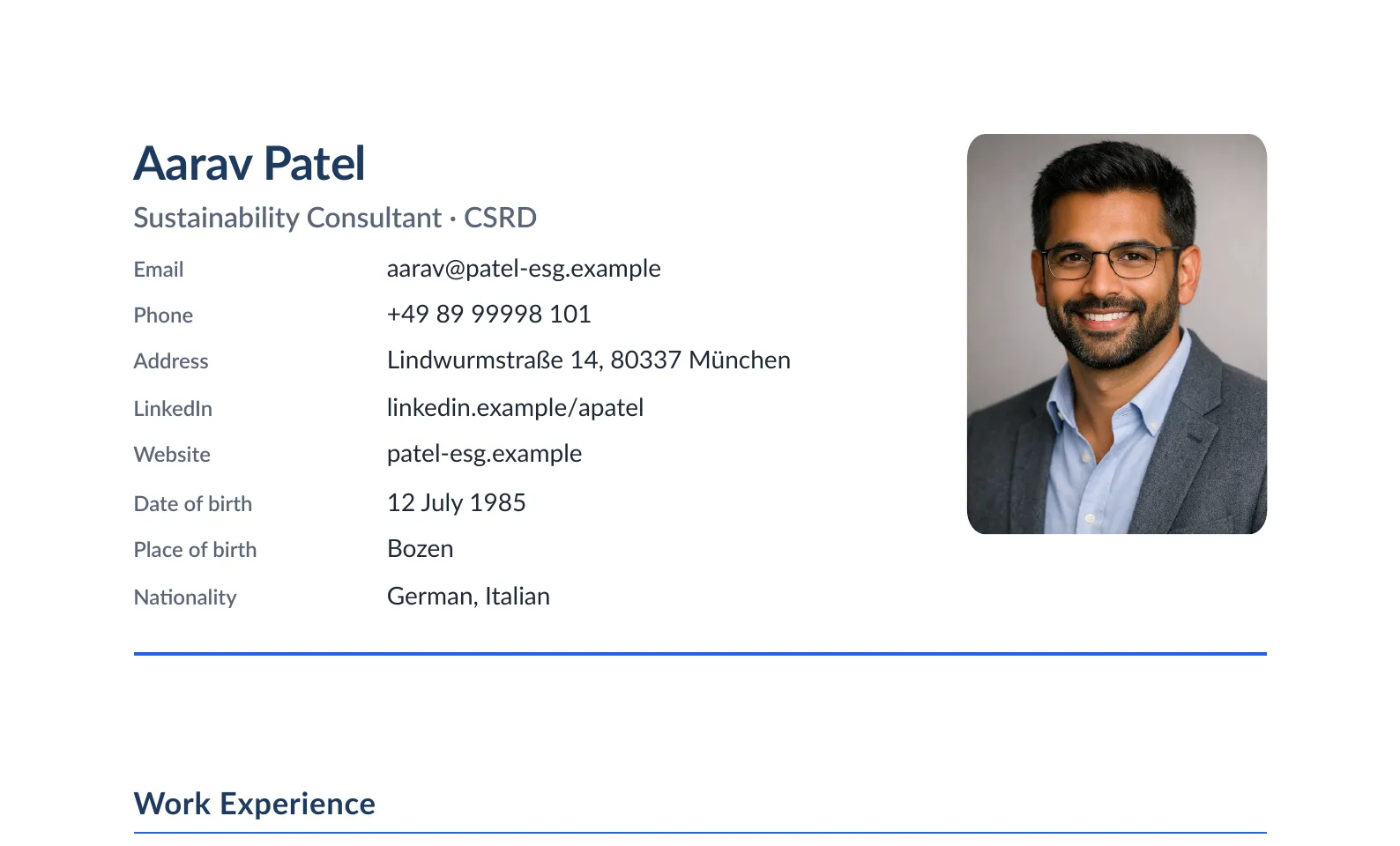
English version: Email, Address, Date of birth, Nationality — same fields, same positions
What switches is the labeling: E-Mail becomes Email, Berufserfahrung becomes Work Experience. Nationality follows the document language too: German, Italian instead of deutsch, italienisch. Everything else holds: the same order, the same two-column data block, the photo top right. And the most telling part: date of birth, place of birth and nationality are still there. Those three fields would not appear on a US résumé at all. The images show structure and labeling; the wording of each entry is written in whichever language the application is generated in.
Stating your German level
Whichever language you choose, one line in your CV gets read with unusual attention: your languages. Treat it as a commitment, not a formality.
Use a named level, not bars or stars. The German ladder runs Grundkenntnisse (basic) → gute Kenntnisse (good working knowledge) → fließend (fluent) → verhandlungssicher (business fluent) → Muttersprache (native). Put the CEFR band (A1–C2) next to it so the entry reads internationally, and name any certificates (Goethe, telc, TestDaF, DSH).
Writing both is also the machine-readable choice. Applicant tracking systems filter on language requirements, and a skills graphic contains no readable text at all for them — while a bare CEFR band is ambiguous, since “B2” is also a German driving license class. The written-out level plus the band covers both readers. More on that in the ATS guide.
Then the uncomfortable part: be honest in both directions. The dilemma is easy to name and uncomfortable to sit with — ask for help with a German cover letter and the finished letter shows a level above the one you actually have. That’s the trap. A polished German application sets an expectation your interview will be measured against. An overstated language level that was a hiring criterion can justify termination later on. That isn’t a soft convention; it’s employment-law reality.
German at B2 or C1 is a genuine selling point for an international candidate. B1 stated honestly, with a note that you’re actively learning, is a perfectly respectable line. What costs you is the gap between the CV and the room.
When the process switches language on you
Choosing a language is where the process starts, not where it ends. A common sequence: the ad, your application and the scheduling emails all run in German — and then a colleague who doesn’t speak German joins the interview, and the conversation switches to English. Or the exact reverse.
It’s rarely announced. One candidate describes asking more than once and getting nowhere with it: the interview language hadn’t been settled yet, or it would depend on whoever ended up running the conversation, and either way the advice was to arrive ready in both. Not at improvised little firms, either — the employers in that account were household names.
The employer side of this is a live question too: a hiring manager whose entire process had run in German asked openly whether she owed the candidate a heads-up. The answer she got was yes. Plenty of companies still don’t give one.
You can prepare for it anyway, because the posting usually telegraphs it: an explicitly required language level, a reference to an international team, an international parent company. If any of those apply, run your three standard passages — career summary, motivation, your own questions — out loud once in each language. Not memorized; just once out loud. The gap between “rehearsed once” and “completely cold” is much wider in a second language. The interview guide covers the rest of the format.
Which language — at a glance
14 signals and rules from the job ad to the interview — click to expand
The quick reference. One thing to hold on to while reading it: every row on the left is about language, every row under “what stays German” is about format — and the two are decided separately.
Signals in the posting
| Signal | Apply in |
|---|---|
| The ad is written in English | English |
| The ad is written in German | German |
| The ad names a required German level | German |
| Careers page and application portal are English | English |
| Genuinely ambiguous, bilingual employer | German (the lower-risk default) |
What stays German, whichever language you write in
| Element | Convention |
|---|---|
| Structure | tabular, reverse-chronological |
| Personal-data block | at the top, with a photo if you choose to include one |
| Dates | month/year, no year-only entries |
| Gaps | accounted for — the German CV is expected to be complete |
| Signature | optional but customary — place, date and signature at the end |
What actually changes with the language
| Element | In the English version |
|---|---|
| Section headings | Work Experience, Education, Skills |
| German qualifications | keep the original term, add a short gloss |
| Language line | named level plus the CEFR band |
| Tone | slightly more active, still factual — not a sales pitch |
Austria and Switzerland
The same logic holds across DACH — match the posting, default to the local language when unsure. In Switzerland, note the language region too (German-, French- or Italian-speaking); in Austria, German is the safe default. The full process guide covers the regional differences.
Get both versions right
JACVault builds your application to German conventions in the language you need — the CV and cover letter tailored to each role, formatted correctly either way.
Under the hood it works the way this guide describes. JACVault reads the posting’s language from the text itself, rule-based with no AI involved. You still decide: pick German or English before the run, or leave it to the detection. And if the posting’s language doesn’t match the language of your profile, it doesn’t guess. It stops and asks, and that question costs you no extra credit. What never changes is the structure: language is one setting, target market is the other, so the section headings switch with the language while the German layout stays.
Recommendation: apply in English. Your facts stay your facts, and the prose is written directly in English.
- The app in German or English switch with one click
- One language per profile detected automatically on import
- Your application in the posting’s language or pick it yourself, on every plan
See how it works for internationals on the CV & Resume Builder for Germany page — your first application is free.
Start for free → · The German CV guide · The full application process
General information, not legal advice. Last reviewed: see the date at the top.