In short: A German cover letter (Anschreiben) is exactly one page, formally laid out (the DIN 5008 business-letter norm), and opens with a named salutation. It’s factual, not a US-style sales pitch — and German recruiters weight it heavily. Put salary expectations and your start date, if asked, in the closing paragraph.
Germans treat the Anschreiben as seriously as the CV — sometimes more. Where a US cover letter is a short, punchy pitch, the German one is a formal, structured letter that proves you understand the role and the local standard. Here’s how it’s built — and if a German term is unfamiliar, the glossary has it.
The structure (top to bottom)
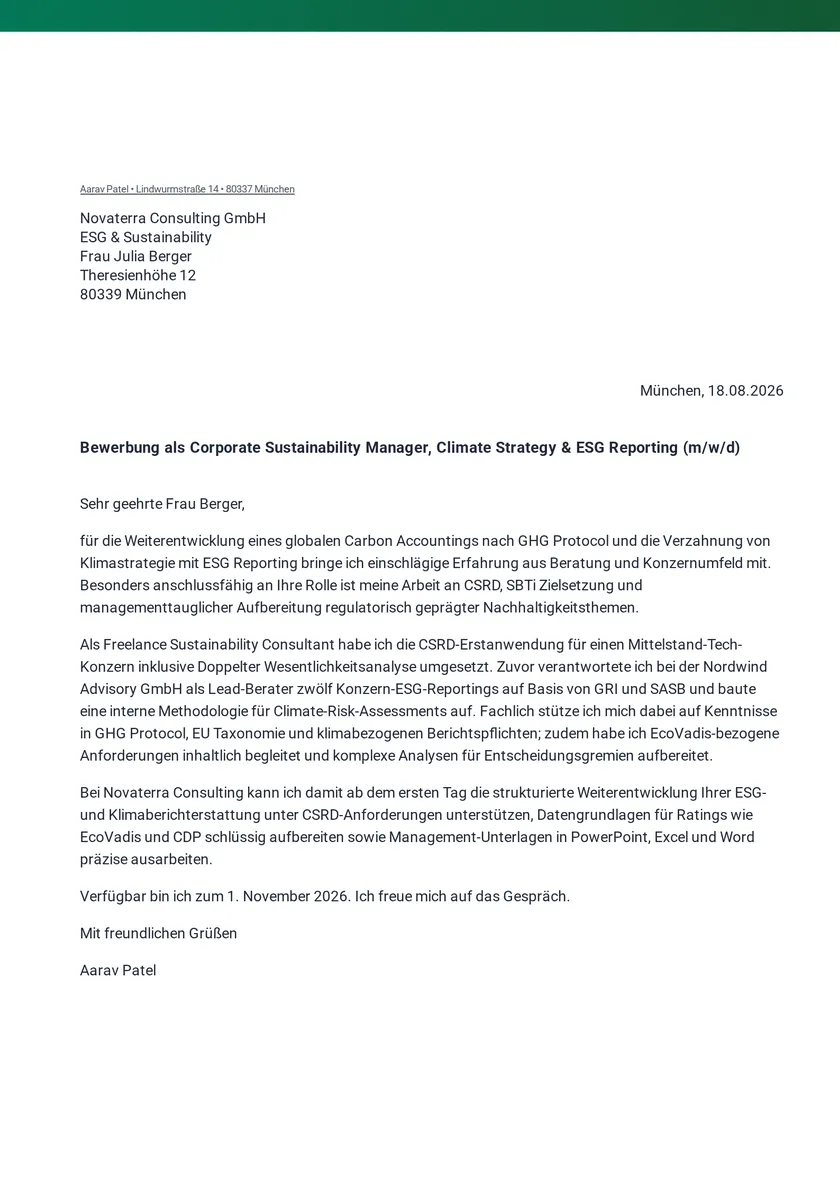
The Anschreiben follows the DIN 5008 business-letter layout. Top to bottom:
- Your details (sender), then the recipient block — company, named contact with title, address.
- Place and date, right-aligned (
Berlin, 4 July 2026). - The subject line (Betreff) — see below.
- Salutation (Anrede) — “Sehr geehrte Frau Meyer,” / “Sehr geehrter Herr …,”. A comma always follows, and the first body word continues lowercase. Use “Sehr geehrte Damen und Herren” only if you genuinely can’t find a name.
- The body — three threads: why this role, why you (with proof), why this company.
- Closing paragraph — signal you’re ready for an interview and ask for a reply. Salary and start date go here.
- Sign-off (Grußformel) — “Mit freundlichen Grüßen”. Never a comma after it. Leave space, then your full name (and ideally a handwritten signature).
One page, hard limit — roughly 250–400 words in 3–4 paragraphs. Left-aligned, not justified.
This is what the finished letter looks like — a real render, DIN 5008 applied:
The subject line (Betreff)
Small line, big conventions:
- Don’t write the word “Betreff” before it — that’s outdated.
- No closing punctuation — no period, no exclamation mark.
- Name the exact job title from the ad, plus any reference number (Kennziffer) it gives.
The opening: kill the clichés
A German cover letter does not begin with “Hiermit bewerbe ich mich” — that’s already in the subject line. It begins with the strongest reason you fit the role. German recruiters have read every stock opening thousands of times, and — this matters for internationals — the stock phrases are exactly what translation tools and old template collections produce. If you draft in English and translate, or copy a German Muster from the web, you’ll land on one of these:
| The cliché | What it means — and why it’s burned | Instead |
|---|---|---|
| ”Hiermit bewerbe ich mich als …" | "I hereby apply for …” — it only repeats what the subject line and the act of applying already said | Open with your strongest professional reason for this role |
| ”Mit großem Interesse habe ich Ihre Stellenanzeige gelesen" | "I read your job ad with great interest” — an empty truism; nobody applies without interest | Name the concrete reason it’s this company |
| ”Sie suchen X? Dann bin ich genau der Richtige!" | "You’re looking for X? Then I’m exactly the right one!” — ad-copy manner, reads pushy rather than confident | Prove the qualification factually instead of claiming it |
| ”Ich bin auf der Suche nach einer neuen Herausforderung" | "I’m looking for a new challenge” — says everything about your wish to leave, nothing about the role | Connect to the concrete task that’s advertised |
The same discipline applies at the end: “Über eine Einladung würde ich mich sehr freuen” uses the subjunctive würde — in German it reads as hedging, not politeness. Close in the indicative: “Ich freue mich auf ein persönliches Gespräch.” And skip the self-praise adjectives (teamfähig, dynamisch, hochmotiviert) entirely — German advice converges on one rule: claims are worthless, examples with numbers convince.
Formatting at a glance
17 values from page margins to the sign-off — click to expand
The quick-reference card for the letter. Everything is A4 and metric; the measurements come from DIN 5008, which is a guideline rather than a law — but it’s the shape German eyes expect.
Length & structure
| Value | Note | |
|---|---|---|
| Length | 1 page | hard — one A4 page, never a second |
| Word count | 250–400 words | in three to four paragraphs |
| Alignment | left-aligned | ragged right edge, not justified |
| Order | letterhead → signature | sender, recipient, date, subject, salutation, body, closing, sign-off |
| Closing paragraph | 2–4 sentences | interview request in the indicative, no subjunctive |
DIN 5008 measurements
| Value | Note | |
|---|---|---|
| Margins | left 2.5 cm | right 2 cm, top 4.5 cm, bottom 2.5 cm |
| Address field | 8.5 cm wide | nine lines high — sized to the window of a German envelope |
| Date | right-aligned | with the place before it |
Typography & spacing
| Value | Note | |
|---|---|---|
| Body text | 11–12 pt | a legible standard typeface |
| Subject line | bold, 13–15 pt | without the word “Betreff”, without a closing period |
| Subject → salutation | ≥ 2 blank lines | the calm space before the letter proper |
| Blank-line cascade | 1 / 1 / 3 blank lines | salutation to text 1, text to sign-off 1, sign-off to name 3 — room for the signature |
| Line spacing | factor 1–1.5 | consistent with the CV |
| Typefaces | 2 typefaces at most | the same ones as the CV |
Closing blocks
| Value | Note | |
|---|---|---|
| Salary expectation | only if asked | as a gross annual figure, in the closing paragraph |
| Start date | a concrete date | derived from your notice period |
| Sign-off | no comma | ”Mit freundlichen Grüßen” — no punctuation after it (in an English letter there’s a comma; here that’s a mistake) |
Salary expectations (Gehaltsvorstellung)
The rules that trip people up:
- Only state it if the ad asks. If it’s requested and you leave it out, you risk being sorted out for carelessness. If it’s not asked, save it for the interview.
- Where: in the closing paragraph of the letter — never in the CV.
- Always a gross annual figure (Brutto-Jahresgehalt) — never net, never monthly.
- Range vs. single number is genuinely debated: a precise single figure reads as confident and prepared (a specific non-round number even more so); a range signals negotiation flexibility. Either is fine — pick to match your intent.
- Don’t itemize bonuses or benefits — bundle everything into one gross figure.
Example: “Meine Gehaltsvorstellung liegt bei einem Brutto-Jahresgehalt von 46.500 Euro.”
Applying in Austria? One rule surprises almost every international: since 2011, Austrian job postings are legally required (under the Gleichbehandlungsgesetz) to state the minimum salary for the role — usually the collective-agreement minimum, marked with a phrase like “Bereitschaft zur Überzahlung” (willingness to pay above it). So in Austria you’re never guessing blind: your figure calibrates against the number printed in the ad.
How to arrive at your figure — researching your band, anchoring, and the negotiation itself — has its own guide.
Start date and notice period
If the ad asks for your availability (Eintrittstermin), state it — usually in the closing paragraph, just before the interview request.
Your earliest start is driven by your notice period (Kündigungsfrist). Germany’s statutory default is four weeks to the 15th or the end of a calendar month, but contracts (especially senior ones) often stipulate three to six months — check yours before naming a date, and target the 1st or 15th of a future month.
If you have a fixed notice period, a concrete date reads as professional and honest. Use “zum nächstmöglichen Zeitpunkt” only as a genuine fallback — and don’t understate your notice to look available.
Example: “Aufgrund meiner Kündigungsfrist stehe ich Ihnen ab dem 01.10.2026 zur Verfügung.”
Does Germany still expect a cover letter?
Honest answer: mostly yes, with a real countercurrent. Recruiter surveys have shown for years that the clear majority of German recruiters expect a cover letter, and many postings still ask for one explicitly. At the same time the counter-camp is not a myth: in a Robert Half survey of 700 German executives, a quarter said they don’t have time to read cover letters at all, and around half consider them subjective and not very informative. A handful of large employers — Deutsche Bahn and Adidas among them — have partly dropped the requirement.
The practical rule for internationals: let the ad decide. If the posting asks for a cover letter, or the application portal has an upload field for one, it will be read and it will count — omitting it there risks the rejection pile. Where a posting genuinely marks it optional, it’s a real trade-off: a sharp, role-specific letter can still differentiate you, while a generic one adds nothing. What you should never do is skip it by Anglo habit on the assumption that “nobody reads those” — in Germany, that assumption fails often enough to cost you shortlists.
Writing it with AI — without sounding like it
Using AI for the letter is mainstream in Germany: in softgarden’s 2023 study, 19% of applicants had already used AI for their cover letter, and the share has grown sharply since. What recruiters actually detect and reject isn’t “AI text” — it’s generic text: stock phrases, smooth interchangeability, no reference to the specific role. Which is the same thing that sank mass-produced letters long before language models existed. The consequence isn’t “don’t use AI”; it’s “don’t send a letter that could have gone to any company.” Per-role context beats the mass letter, whoever writes it — more on AI and German applications here.
Anschreiben, Bewerbungsschreiben, Motivationsschreiben — untangling the words
Three German words, three countries, and they don’t map cleanly — this trips up more internationals than any formatting rule:
- Germany: the mandatory letter in your application is the Anschreiben (also called Bewerbungsschreiben — those two are synonyms). A Motivationsschreiben is a different, optional document: the “third page” of an application, which goes deeper into personal motivation. You’ll mostly meet it in university admissions, scholarship applications and speculative applications — a normal job application doesn’t need one.
- Austria: officially blurred. The government portal oesterreich.gv.at uses Bewerbungsschreiben and Motivationsschreiben interchangeably, while job portals like karriere.at treat the Motivationsschreiben as a separate add-on document. The gray zone is real — read what the specific posting asks for and match its vocabulary.
- Switzerland: the cover letter itself is called Motivationsschreiben (or Begleitschreiben). Tone runs modest and factual, without superlatives. Swiss spelling is mandatory — no ß (so it’s “Freundliche Grüsse”, not ”…Grüße”), the salary (Saläranspruch) is stated only if asked, as a gross annual figure in CHF, and part-time workload (Pensum) is given in percent, e.g. “80%”.
All three terms — and the rest of the application vocabulary — are in the application glossary.
For internationals
A few things specific to applying from abroad — treat these as practical guidance rather than codified rules:
- State your German level with its CEFR band where it’s a selling point (B2/C1 is a real differentiator). Language details usually live in the CV, but a brief mention in the Anschreiben is worth it when it helps your case. Which language you write the Anschreiben in is a separate decision — it follows the language of the job ad, exactly like the CV.
- Work authorization: if you already hold it (EU citizen, existing permit, Blue Card eligibility), a short positive mention removes the employer’s uncertainty. If you’d need sponsorship, it’s usually better raised once there’s interest, not front-loaded.
- Relocation: if you’re not local, a brief line signaling readiness to relocate reassures the employer.
Tone and common mistakes
Germans expect understatement backed by evidence — factual, restrained, confident, with strong verbs and no inflated adjectives. The mistakes internationals make most:
- Spilling past one page — the cardinal sin.
- A US-sales-y tone — superlatives and hype read as unserious here.
- Generic / non-individualized letters, or the wrong company or contact name.
- Just restating the CV in prose — the Anschreiben should add, not repeat.
Let JACVault write the first draft
JACVault writes the Anschreiben from the same knowledge that builds your CV — one profile, one set of facts, and the letter as the more personal voice rather than a prose retelling of the CV. The output rules ban exactly the clichés listed above: no “Hiermit bewerbe ich mich”, no empty self-praise, nothing that isn’t backed by your profile — tailored to the specific role, in the language of the posting, DIN 5008 applied. Your first application is free. See how the cover letter generator works — editable in place, in the same layout as your CV.
Start for free → · Back to: the full application process · Next: the German CV
General information about German cover-letter conventions, not legal advice. Notice-period rules depend on your contract — check it. Last reviewed: see the date at the top.