In short: A photo on a German CV is legally optional but still customary — an employer may not require one, yet most applications carry one. Use a professional photo, placed top-right of the CV (or on a cover sheet), classic size 4.5 × 6 cm, portrait. German career portals put a studio shoot at €50–150. Leaving the photo off is a legitimate, legally protected choice — a CV without one is a complete application. If you’re applying in the US or UK, do the opposite and omit it.
It’s the detail internationals find strangest — putting your face on a job application feels wrong if you come from an Anglo market, where the same move can get your CV set aside. In Germany it’s simply the convention, and it comes with its own rules: a size, a place on the page, an expectation about how the picture looks. This guide covers all of it, plus the two questions the German guides never answer for you: is this even legal, and where do you actually get such a photo once you’re here. For the CV itself, see the German CV guide.
Why Germany still does this
The German CV (Lebenslauf) is a document tradition, and the photo is part of it. It is not a hiring tool anyone defends in principle — it is a habit that outlived the law that was meant to end it. Since 2006, the anti-discrimination act (Allgemeines Gleichbehandlungsgesetz, AGG) has made it illegal for an employer to require a photo, and job ads today almost never ask for one outright, because an ad itself must not breach the equal-treatment rule. The custom held anyway, most visibly at smaller companies and family businesses, where the personal impression carries weight.
How many employers actually expect one cannot be stated honestly. You will see specific percentages quoted for it, but we found none that rests on a traceable survey — most trace back to companies selling application photos. What holds up is the qualitative statement: the convention persists, most visibly at smaller companies.
For internationals the hard part is rarely the photo itself — it is not knowing which rulebook is in force. One applicant, writing about the European branch office of a US employer, reduces it to a single question: does a CV for Germany or Switzerland genuinely need a face on it, when everything they were taught at home says the opposite? Their own answer is a resigned yes. Locally, they write, the picture is simply part of what an application consists of, and sending one without it marks you as the candidate who handed in something unfinished. Whether the rule deserves to exist is a separate argument — and not one you get to have while your file is being sorted.
That is a fair description of the situation, and it deserves an honest answer rather than a reassuring one: including a photo is the conventional choice, omitting it is a legitimate one, and neither is a mistake. The rest of this guide gives you what you need to decide — and to execute either version well.
One practical signal before the rules: the job ad tells you more than you think. German ads that ask for vollständige Bewerbungsunterlagen (“complete application documents”) or eine aussagekräftige Bewerbung are quietly assuming the traditional package, photo included. Ads that explicitly ask for an application ohne Foto mean it literally. And when the posting is written in English by a global company, be careful what you read into that: the language of an ad tells you which language to write in, not which format to use. An English ad from an employer based in Germany is still answered with a German-standard CV, photo and all — the two decisions are made separately. What genuinely reopens the photo question is where the process runs rather than what language it runs in: a file that lands with HR abroad is read against that market’s rules, and that case is covered under when to leave it off. If the posting doesn’t make clear which of the two you’re dealing with, ask.
But isn’t this discriminatory?
The concern is reasonable, and it is worth stating plainly rather than talking around. A photo reveals things a hiring decision is not supposed to rest on — age, gender, ethnicity, sometimes religion. The worry that this gets used, consciously or not, is not paranoia; it is the reason the law exists in the first place.
Here is what German law actually gives you.
The protection. The AGG aims to prevent disadvantage on the grounds of ethnic origin, gender, religion or belief, disability, age, or sexual identity (§ 1 AGG). Applicants may not be disadvantaged on those grounds (§ 7 AGG), and a position may not be advertised in breach of that rule (§ 11 AGG). Concretely, for you: an employer cannot demand a photo, and cannot hold a missing one against you. A CV without a photo is a complete application, not an incomplete one.
The limits, honestly stated. The law protects you from being disadvantaged; it does not stop a photo from creating an impression once you’ve supplied one, and it does not make an unfair shortlist easy to challenge. The AGG does shift the burden of proof: if you can show indications (Indizien) that suggest discrimination on a protected ground, the employer then has to prove that other reasons applied (§ 22 AGG). But Germany’s Federal Anti-Discrimination Agency is clear about the bar in front of that: being rejected despite being well qualified is not on its own an indication, nor is a generic rejection, nor is not being invited despite meeting every requirement. What can count: contradictory reasons for the rejection, questions about protected characteristics in the interview, or a job ad that itself refers to one. And where a breach is established, the claim is for compensation — capped at three months’ salary for a non-hire if you wouldn’t have got the job anyway — never for the position itself (§ 15 AGG). Claims have to be raised in writing within two months.
What some employers do about it. Anonymized application procedures exist: the photo, name, address, date of birth and any details about age, gender, marital status or origin are stripped out, and only the qualifications are assessed. Germany’s Federal Anti-Discrimination Agency ran a nationwide pilot for this in 2010, and individual public-sector employers work this way. It is not standard practice, but you will meet it — and it can go further than dropping the photo: one applicant describes a form that drops the photo, the first name, and even an e-mail address that contains one. Where a process is anonymized, the ad says so, and you follow it exactly.
So the answer is: yes, the concern is legitimate; no, you are not obliged to hand over a photo; and if you’d rather not, that choice is protected. The section on when to leave it off goes through the cases where omitting it is simply the better call.
The specs
There is no legal standard for the size — several German portals say so outright. What exists is a convention, and it is remarkably consistent:
- Placement: top-right of the CV, on the first page, next to or above the personal-details block. Top-left appears too and is not wrong.
- Size: 4.5 × 6 cm, portrait orientation — a 3:4 ratio, slightly larger than a passport photo.
- Crop: head and shoulders (a Halbporträt, what English calls a headshot). The bottom edge sits around chest height, with a little space above the head. No full-body shots.
- Cover sheet: if you use an optional cover sheet (Deckblatt), the photo goes there instead — around 6.5 × 9 cm is a common figure, and square or large formats are accepted. The rule behind it: the photo appears exactly once in the application. Cover sheet or CV, never both, and never on the cover letter.
- File: JPG or PNG at 300 dpi, without heavy compression, exported inside a text-based PDF.
And if you’re still deciding whether to write the CV in German or English, that’s a separate call — see CV in English or German.
Your file, the PDF and the ATS
How the photo gets into the document decides how it arrives. Three rules cover it:
- Keep the file settings from the list above. Below that resolution the picture prints soft and looks mushy on screen; heavy compression shows up as blocky edges around hair and collar.
- Place the photo in the CV and export the whole document as a PDF. That freezes layout and image quality, whatever the recipient opens it with — and it is what German employers expect to receive.
- Never send an image-only PDF. A scanned or flattened CV carries no machine-readable text at all.
That third rule is the one worth understanding, because it also answers the applicant-tracking-system worry that internationals arrive with. The photo itself is just an image to a parser — nothing is read out of it, and it doesn’t break anything. What breaks things is putting information into the picture: your name, contact details or job title belong in the document as real text, never as part of a graphic. If a system can’t find your name, the photo is not what cost you the shortlist.
The German market does run applicant tracking systems, and the rest of the CV has to survive them too — that side of it lives in the ATS guide.
What the photo should look like
A German application photo is not a portfolio portrait. It should look professional and show you recognizably — that’s the whole brief. Four things decide it, and none of them is about your face:
- Background: calm and neutral — light gray, gray, white or beige. Bookshelves, patterns and living rooms pull attention away. Modern shots taken in an office or against a window work too, with the background deliberately out of focus.
- Light: even and soft, no hard shadows on the face, no color cast. Overhead lighting and direct flash produce exactly what you don’t want.
- Clothing: what you would wear to the interview, calibrated to the industry — and if you’re unsure, one notch more formal rather than two. That is the line the German career portals take without exception: lebenslauf.de says wear the outfit you would turn up in for the interview, Stepstone sorts the level by sector, and Switzerland’s jobs.ch adds the negative rule — don’t dress up as someone else. A bank means a shirt and a jacket; an agency means a well-kept top. Loud colors, busy patterns, headwear and eye-catching accessories pull attention off you. The part that matters for a newcomer: the level is set by the industry, not by the country. There is no default German suit.
- Expression and posture: look into the lens, turn your upper body slightly, keep your head toward the camera, and allow a light smile. Worth knowing: a forced smile reads worse than none at all, so if smiling on cue is hard for you, have several versions taken and pick calmly afterwards.
One more: the photo should be no more than about a year old, and above all it should look like you will look in the interview. New glasses, new haircut, beard gone — take a new one.

Studio: neutral background, even light, head-and-shoulders crop

Selfie: living room behind, casual shirt, tilted angle

Holiday shot: leisure context, background competes for attention

Overhead light: hard shadows, color cast, image noise
What separates them is context and technique — where the picture was taken, what light there was, which occasion the clothing signals, how tight the crop is. All four are things you can control, which is what the next section is for.
Getting one in Germany
This is the part no guide written for Germans bothers to explain, because everyone here already knows it: there is an entire small industry for this. The German word is Bewerbungsfoto, and it is the search term. Type it together with Fotostudio (photo studio) and your city into a map or search engine, and you’ll find studios that sell it as a named, fixed-price package — it is a standard product, not a custom commission.
How the appointment works. Book ahead; in larger cities a week or two is realistic. Say what the photo is for and which industry you’re applying to — the photographer will set light, crop and pose from that. Bring one or two outfits: one clearly professional, one you feel comfortable in. With a change of clothes, expect around an hour. Ask for several shots in different poses rather than a single frame; you’ll want options for different applications and for your profile.
What it costs. The large German career portals put a professional application photo at €50–150, depending on the studio, the length of the session and the retouching included — Stepstone and Karrierebibel both quote that range. The spread is wider at both ends than a single figure suggests: lebenslauf.de puts simple shots without much consultation at €20–40 and azubiyo names €20–30, while a full session with styling and retouching often starts at €100. Austria’s public employment service (AMS) quotes a similar entry point of around €50, and in Switzerland jobs.ch names CHF 50 and up.
If money is tight: applicants registered as unemployed can have application costs covered by the Agentur für Arbeit (the federal employment agency) from its placement budget (§ 44 SGB III). It is a discretionary benefit, so talk to your contact there and apply before you book — submitting an invoice afterwards generally doesn’t work.
One thing almost nobody tells you: you don’t automatically own the picture. Being the person in the photo doesn’t make you the rights holder — copyright in the image sits with the photographer (§ 72 UrhG), and what you receive is a license whose scope is agreed between you (§ 31 UrhG). Using it in your application is uncontroversial. Using it as a LinkedIn or Xing profile picture, on your own website, or in a company profile needs explicit permission. Settle that before the shoot, get it in writing, and ask for the digital file at print resolution while you’re at it — a paper print is of no use in an online application.
Your LinkedIn photo and AI photos
LinkedIn first. A profile picture may be a shade more relaxed than an application photo — different medium, different context. Still, check it in both directions. Recruiters do look at profiles, certainly in the later rounds, and if the two pictures read like two different people, that creates friction for no reason. A second frame from the same session solves it neatly. Conversely, an existing profile picture is not automatically usable as an application photo: check the crop, the resolution, the background — and the usage rights, if a photographer took it.
Then AI. Providers now promise professional headshots generated from a handful of uploaded selfies, in minutes, for less than a studio charges. The German advice landscape is genuinely split on this. Karrierebibel advises against it (“recruiters want to see you, not a generated ideal”); lebenslauf.de treats specialized providers as a reasonable alternative in its main text — while its own FAQ on the same page calls AI photos “not recommended”. Austria’s AMS and karriere.at don’t discuss the tooling at all but warn against heavy retouching, beauty filters and artificial effects.
More solid than any of those opinions is one piece of evidence. In an online experiment at Osnabrück University of Applied Sciences (Uwe P. Kanning and Andrea L. Sander, 259 participants, published in Personalmagazin 8/2026), the same application was presented in four versions — with no photo, with a natural photo, and with photos altered by AI to a mild and to a strong degree. The altered images scored consistently worse, both on perceived suitability and on the likelihood of an interview invitation, and the degree of alteration barely mattered: small changes were enough. The usual caveat applies — one experiment, one fictional candidate, one trainee position.
The practical line is not a ban on tools but a test of what the picture is doing. Adjusting light, color and contrast, or removing a blemish, is what every studio does anyway. A smoothed, reshaped, “optimized” face is a different thing. Ask yourself whether the person in the interview will match the person in the frame. If not, the photo has set an expectation you’ll spend the first thirty seconds correcting.
When to leave it off
“No photo is better than a bad one” is the standard German line, and it’s the right starting point. Beyond that, there are cases where leaving it out is simply correct:
- The ad asks for an application without a photo. Then send none — it’s there deliberately, usually because the process is anonymized.
- You’re applying in the US, UK or another Anglo market, or through a global process run to US standards. There a photo can get the application set aside for bias reasons. That flip is a topic of its own, and we keep it on our US site: Resume photo: the U.S. versus Europe.
- The role is at an international company whose HR sits abroad. Take the cue from the language and the wording of the posting, and when in doubt, ask.
- You don’t have a professional photo and can’t get one before the deadline. An improvised picture costs you more than a missing one.
- You’d rather your appearance or your background not be the first thing assessed. German career portals list this among the legitimate reasons to omit a photo, and it needs no justification to anyone. Without a photo, your appearance is simply not a criterion at that stage — the choice is yours, and no one may hold it against you.
Worth knowing before you agonize over it: in the Osnabrück experiment above, the photo brought no advantage over an application with no photo at all when it came to the selection decisions, and its absence produced no meaningful downgrade of the candidate. One study, one setting — but a clear signal that a CV without a photo is not a handicap as long as the rest of it holds up.
That doesn’t contradict the rest of this page — it resolves it: the photo is a social expectation, not a proven advantage in the selection — which is why a good photo is the conventional choice and leaving it off is a legitimate one.
Photo specs at a glance
12 values from size to Austria and Switzerland — click to expand
The quick-reference card. One thing first: there is no legal standard for a German application photo — the values below are the convention the German career portals have settled on.
Size & placement
| Item | Value | Note |
|---|---|---|
| Size on the CV | 4.5 × 6 cm, portrait | convention, not a rule; 3:4 ratio |
| Placement | top-right, first page | beside or above the personal details; top-left also appears |
| Cover sheet (Deckblatt) | approx. 6.5 × 9 cm | more freedom — then not in the CV as well |
| Crop | head and shoulders (Halbporträt) | bottom edge around chest height |
| Cover letter (Anschreiben) | no photo | the photo appears exactly once in the application |
File & print
| Item | Value | Note |
|---|---|---|
| File format | JPG or PNG | no heavy compression |
| Resolution | 300 dpi | below that it prints soft |
| Document | text-based PDF | never a scan or a flattened image |
| Age of the photo | about a year, max | sooner if your appearance changed |
Austria & Switzerland
| Country | Expectation | Size and specifics |
|---|---|---|
| Austria | customary, not required (Gleichbehandlungsgesetz) | approx. 4.5 × 6 cm, top-right or top-left (AMS) |
| Switzerland | the strongest expectation of the three | approx. 4 × 5 cm, at the top of the CV (jobs.ch) |
| DACH overall | one professional photo works for all three | some large employers explicitly invite applications without a photo |
Austria and Switzerland
The practice is similar across the DACH region, but the legal basis and the details differ.
Austria. A photo is not required here either — the protection comes from Austria’s own equal-treatment act (Gleichbehandlungsgesetz, GlBG) rather than the German AGG. It remains customary, particularly in roles with personal contact. Austria’s public employment service (AMS) gives the size as approximately 4.5 × 6 cm at a 3:4 ratio, placed top-right or top-left next to the contact details — the same values as Germany. Costs start at around €50 per AMS, with karriere.at quoting €70–150. karriere.at also notes that applications without a photo are becoming more common.
Switzerland. The expectation is strongest here. The official arbeit.swiss application brochure treats “a CV with a photo” as the normal e-mail attachment and lists the photo as an optional item in its document checklist. jobs.ch gives approximately 4 × 5 cm as the standard, slightly larger being acceptable, positioned at the top of the CV. The counter-movement exists in Switzerland too: some large employers now state explicitly that you may apply without a photo, to avoid discrimination. A professional shot starts at around CHF 50.
In short: one good photo works across all three markets. What changes is the legal basis and a millimeter or two — not what the picture has to look like. For the wider process differences, see the full process guide.
What happens to your photo after a rejection
Almost nobody asks this before sending an application, and almost everybody asks it after the third rejection: where is that picture now? There is no special rule for the photo — it is part of your application file and travels with it.
There is no statutory retention period. Neither the GDPR nor Germany’s federal data protection act sets a deadline for applicant data; the data protection authority of Lower Saxony states in its FAQ that no fixed retention or deletion periods exist. What applies is the general rule: once the purpose is gone — and the purpose was filling this one position — the data has to be deleted (Art. 17 GDPR).
Why months usually pass anyway. An applicant who believes they were discriminated against can raise a compensation claim under the AGG. That claim has to be raised in writing within two months of the rejection arriving (§ 15 (4) AGG), and a further three months remain to take it to court (§ 61b (1) ArbGG). For that whole stretch the employer may have to defend itself — and it needs the documents to do so. Two plus three months plus a buffer for postal delays is where the rule of thumb comes from that supervisory authorities and German employment-law publishers give alike: roughly six months after the rejection; Berlin’s data protection commissioner puts it at six months maximum. Read it the right way round, though: that is a ceiling, not a standard — and a derivation, not a statute.
A talent pool needs your consent. If a company wants to keep your file for future openings, the rejection ends the legal basis it had. What it needs instead is your explicit, informed consent, with a stated purpose and a limited duration — and you can withdraw that at any time, without giving reasons.
Paper applications. There is no reliable right to have a paper folder sent back; one German local court expressly called returning it a courtesy rather than a duty. It may not simply go in the bin either: as a rule, documents are returned or destroyed in a data-protection-compliant way. The practical consequence for you — never send original certificates, and if you do send paper, include a stamped, self-addressed envelope.
What you can do yourself. You can ask what data is stored about you, where it came from and how long it is meant to stay (Art. 15 GDPR) — that is normally answered within a month (Art. 12 (3) GDPR). And you can ask for deletion (Art. 17 GDPR). If you are not pursuing a discrimination claim yourself, the reason for the longer retention falls away, and German practitioners treat the deletion request as taking precedence. An informal e-mail to the address in the company’s imprint or privacy policy is enough.
And if it works out: on hiring, the documents move into your personnel file — but only what is genuinely needed for the employment relationship. The rest is to be returned or deleted.
Handle it automatically
Here is the same CV header with and without the photo — with it off, no frame and no reserved space are left behind:
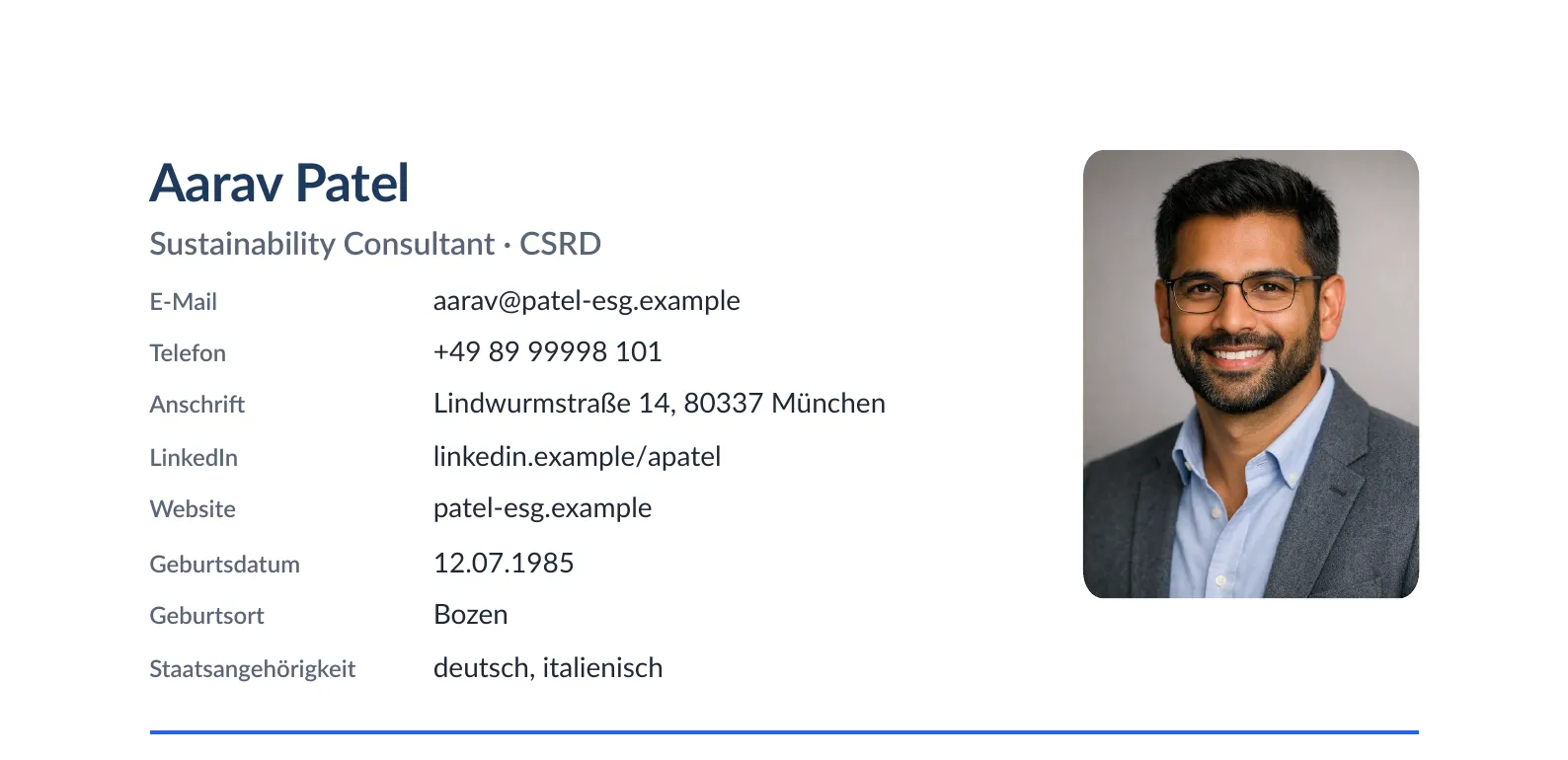
With photo: top-right, beside the personal details
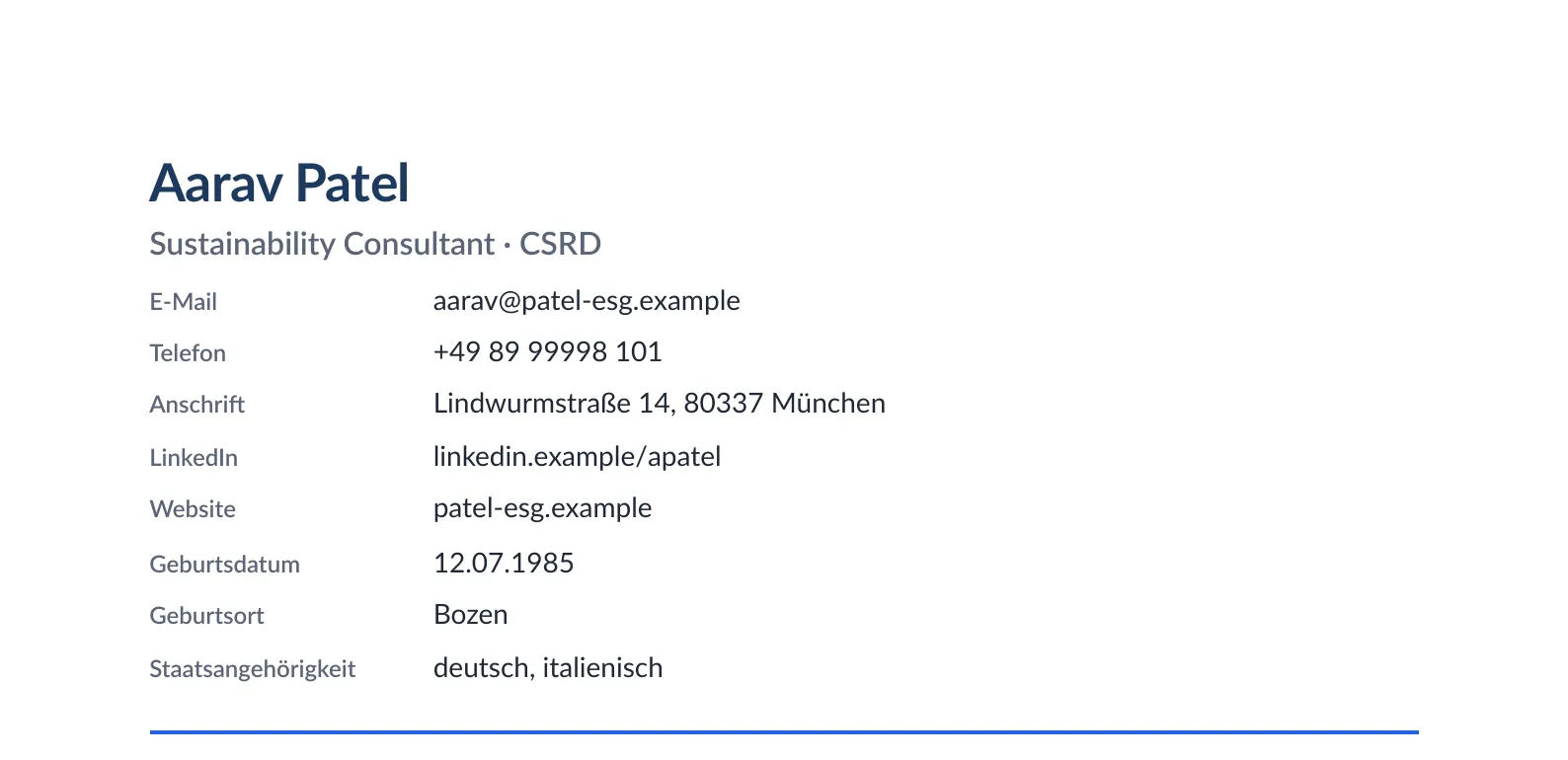
Without photo: same header, no hole and no placeholder
Upload a photo to your profile and JACVault crops it to the classic 3:4 ratio — the 4.5 × 6 cm this page is about — and places it at 300 dpi in the document. Whether it appears at all is a per-layout setting, and “no photo” is one of the options: with the photo off, the header stays complete, with no empty frame and no reserved space. Switch the same application to the US market and the photo is dropped automatically, because there it shouldn’t be there in the first place. Your first application is free.
Start for free → · The German CV guide · Application glossary
General information, not legal advice. Last reviewed: see the date at the top.